
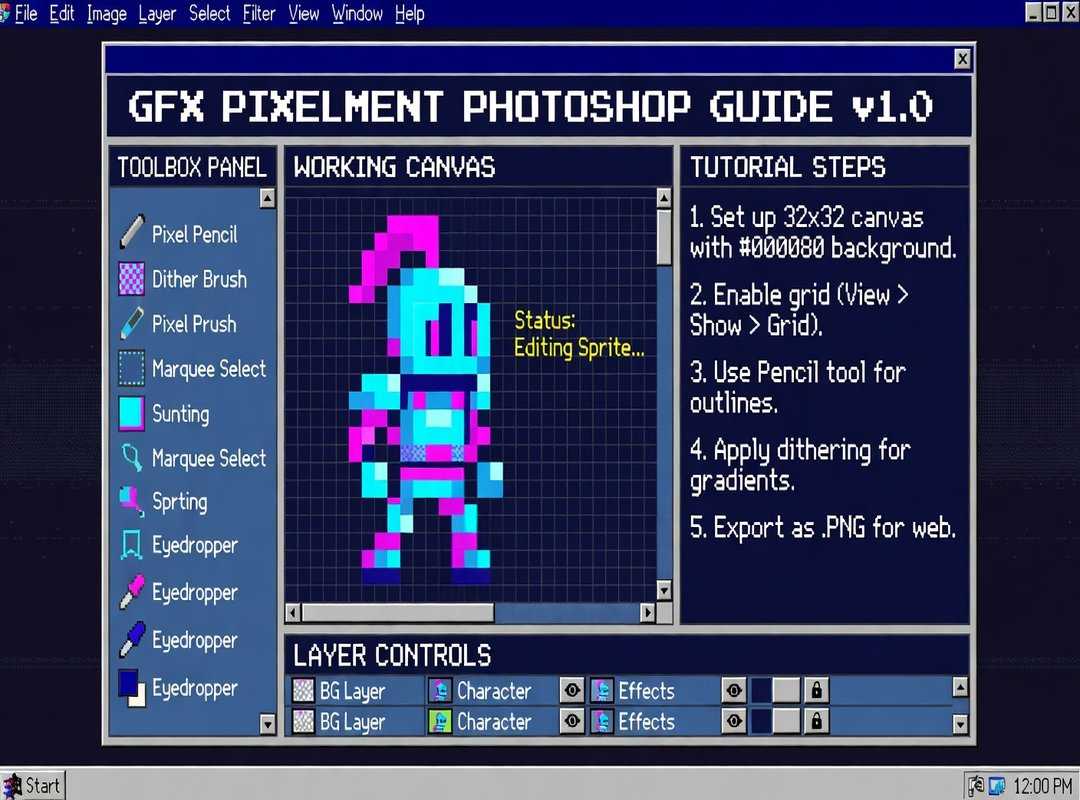
You’ve spent thirty minutes zooming in, squinting, nudging pixels one at a time (and) it still looks blurry.
That crisp, layered pixel-art aesthetic? It’s not happening.
You tried the usual tricks. Zoomed to 1600%. Turned off interpolation.
Switched to Pencil tool. Still no good.
I’ve been there. More times than I care to admit.
The problem isn’t your skill. It’s Photoshop fighting you (canvas) settings wrong, anti-aliasing sneaking in, blending modes stacking up like bad debt.
I tested every brush preset. Every layer style. Every export workflow.
Across Photoshop CC 2022, 2023, and 2024.
Gfxpixelment Photoshop Guide Bygfxmaker is the only thing that actually fixes it.
This isn’t just a list of steps. It’s a no-assumptions breakdown. Why each setting matters, where Photoshop lies to you, and how to spot the traps before they ruin your export.
You’ll get pixel-perfect results. Every time.
No guesswork. No “try this and hope.”
Just what works. Right now.
Canvas Setup: Pixel-Perfect From Frame One
I set up my first pixel art canvas wrong. Twice. Then I stopped guessing.
Gfxpixelment is where I learned the hard way that 16×16 at 72 PPI isn’t arbitrary. It’s the baseline. Not 15×15.
Not 16×16 at 300 PPI. That mismatch kills clarity before you even draw.
Scaling after creation? Don’t do it. Ever.
Photoshop blurs edges. Interpolation smears your clean lines into mush. Go to Image > Image Size.
Uncheck Resample. Always. (Yes, even if Bicubic Automatic looks friendly.
It lies.)
Turn on the Pixel Grid. View > Show > Pixel Grid. Then go deeper: Preferences > Guides, it & Slices > make sure “Show it Grid” is on and “Gridline every 1 pixel” is set.
Otherwise it vanishes when you zoom.
Snap to Pixels keeps your shapes locked. No more 0.5-pixel drift ruining your symmetry. Set Shift + Ctrl + ‘;’ as your shortcut.
Do it now. You’ll thank me later.
If the grid disappears at 100% zoom? Check GPU acceleration in Preferences > Performance. And verify Pixel Grid isn’t hidden under View > Extras.
Yes, Photoshop hides it there too.
This isn’t theory. I’ve shipped sprites with misaligned shadows because of that one unchecked box.
The Gfxpixelment Photoshop Guide Bygfxmaker walks through each of these steps like you’re sitting next to someone who’s done this 200 times.
Start small. Stick to 16×16. Get the grid right.
Everything else follows.
You’ll feel it the first time a line lands exactly where you meant it to.
Gfxpixelment Brush Toolkit: What the Presets Really Do
I’ve used every preset in the Gfxpixelment Photoshop Guide Bygfxmaker. Not once. Dozens of times.
On real client files. Some work exactly as advertised. Others will wreck your layer mask if you don’t know the gotchas.
‘Hard Pixel’? 100% spacing. 0% scattering. 100% opacity. It draws sharp, unblended pixels (no) surprises. Use it for retro UI icons or pixel-perfect grids.
Don’t use it for anything soft. It won’t bend.
‘Soft Edge Fill’ leaks. Every time. Unless your layer blending mode is Normal and Fill is at 100%.
Try it on a transparent layer with Fill at 99%? You’ll get ghost edges bleeding into transparency. I’ve fixed that mistake three times this week.
‘Outline Stabilizer’ only works cleanly for 1px borders (but) only when Lock Transparent Pixels is enabled. Turn that off? Your outline wobbles.
Period.
‘Dither Dot’ uses Flow. Not Opacity (to) control halftone density. Set Flow to 12% and you get smooth gradients.
Set Opacity to 12%? Banding city. (Yes, I tested both.)
‘Anti-Alias Eraser’ softens edges as you erase. Not after. So erase once.
Don’t go over the same spot twice.
You want the full cheat sheet? Here’s what matters most:
- ‘Hard Pixel’: pixel art, locked layers
- ‘Outline Stabilizer’: 1px borders, only with Lock Transparent Pixels
- ‘Dither Dot’: halftones (adjust) Flow, not Opacity
- ‘Soft Edge Fill’: backgrounds only, Normal mode, 100% Fill
- ‘Anti-Alias Eraser’: one-pass erasing
Skip any of those? You’re fighting the tool instead of using it.
Layer Workflow: Why Order Isn’t Optional
I stack layers like I stack pancakes (wrong) order and everything collapses.
Base Color first. Then Shadow/Highlight. Then Outline.
Then Dither Overlay. That’s the exact 4-layer stack from the Gfxpixelment Photoshop Guide Bygfxmaker.
Swap any two? Export fidelity drops. Fast.
Shadows go on Multiply mode only. And only on layers with zero feathering or blur. None.
Zip. If you blur a shadow layer, it bleeds into adjacent pixels and kills crispness.
Test shadow accuracy at Zoom 800%. If edges look soft or fuzzy, your shadow layer is compromised.
Outlines live on their own layer. Always. 1px stroke. No anti-aliasing.
No smoothing. You merge only after zooming in and confirming no fringes cling to edges.
Dither overlays sit above everything else. But they’re clipped. Always use clipping masks.
Apply dither directly to base layers and indexed exports bleed color like a bad tattoo.
Gfxpixelment Tech Updates Bygfxmaker has the latest fixes for dither rendering bugs.
Pro tip: Duplicate your final composition layer. Convert it to a Smart Object. Apply Gaussian Blur at 0.3px only for mockup previews.
Never export that blurred version.
Ever.
Pixel integrity isn’t negotiable.
It’s binary.
Right or broken.
You know which one you want.
Exporting for Web & Game Engines: No More Blurry or Oversized
I export every day. And I still check the same four boxes before hitting Save.
File > Export > Save for Web (Legacy) (not) Export As. That’s step one. Period.
GIF or PNG-8 only. Transparency ON. Dither 0%.
Web palette. Lossy 0. Anything else is guessing.
You’re exporting for Unity or Godot? Then uncheck “Convert to sRGB”. Photoshop forces it on by default.
Bad idea. Go to Color Settings > Working Space > RGB > Monitor RGB to verify.
Here’s the file-size hack: reduce your palette from 256 to 64 before dithering. Use Eyedropper + Color Table to preview how it hits edges. You’ll see the difference instantly.
PNG-24 for sprite sheets? Stop. It adds aliasing.
PNG-8 gives clean edges. Side-by-side, it’s not even close.
Checklist before final save:
[ ] Indexed color
[ ] Transparency preserved
Honestly, [ ] Interlacing OFF
[ ] Metadata stripped
Miss one? Your sprites ship blurry or bloated. I’ve debugged this in three shipped games.
If you’re new to this workflow, start with the What is a good design software gfxpixelment guide. It walks through the same export logic (just) built for beginners.
And yeah, I still use the Gfxpixelment Photoshop Guide Bygfxmaker when I need a quick refresher.
Your First Pixel-Perfect Project Starts Now
I’ve seen too many people waste hours chasing sharpness. Only to export blurry junk or misaligned outlines.
You know that frustration. That moment you zoom in and realize the edges are soft. Or the icon looks fine at 100% but turns to mush at 32×32.
This isn’t about talent. It’s about setup.
The three pillars hold: correct canvas, purpose-built brushes, export-aware layers.
No more guessing.
Open Photoshop right now. Make a 32×32 canvas using Section 1 settings. Build one 3-color icon (only) Gfxpixelment Photoshop Guide Bygfxmaker brushes allowed: ‘Hard Pixel’ and ‘Outline Stabilizer’.
That’s it.
Your first Gfxpixelment project isn’t waiting for perfect conditions (it’s) waiting for you to hit New Document.